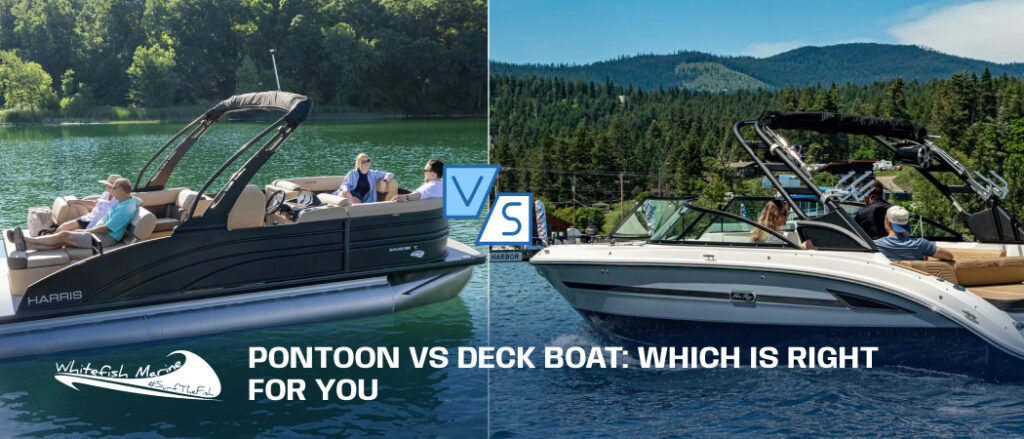
Most families around the Flathead Valley end up on a pontoon. It seats more people, it sits steady when you stop to swim, and everyone can move around without climbing over each other.
Buy the deck boat when your water gets rough or when the main event is a tow rope behind four people. The hull does something a flat deck can’t, and a small group never misses the extra floor.
Both answers have an exception, and the exception is almost always the lake you keep it on. Two buyers with the same family and the same budget can need different boats depending on which water they’re parked at.
Start With How You Will Actually Use The Lake
Picture a normal Saturday with your actual people on board, not the best day of the summer. That ordinary day is the one you’ll have forty times a season, so it’s the day the boat has to fit.
- Six or more aboard, anchoring, swimming, somebody’s parents along: pontoon.
- Four aboard, a tube or skis behind you, in and out in half a day: deck boat.
- A big group that also wants to ski: a three-tube pontoon with real horsepower, not a basic two-tube.
- Fishing with two or three and a cooler: pontoon, for the flat floor and the rail to lean on.
If you read nothing else here, that list is the decision. The rest is how to be sure of it, and what catches people out after they’ve already signed.
What The Two Boats Are
A pontoon is a flat deck sitting on two or three sealed aluminum tubes. Think of a floating patio with a motor on the back. Nothing underneath is shaped to cut through water, so the boat rides on top of it.
A deck boat is a normal fiberglass boat with the bow widened out, so the front becomes seating instead of a point. It has a V hull under it, it gets up on plane, and that hull causes every difference in the table.
| PONTOON | DECK BOAT | |
| Seats | 10 to 14 on a 23-footer | About 8 on a 19-footer |
| Speed with a 115 | Around 26 mph | Around 40 mph |
| Rough water | Slaps, and the front seats get wet | Cuts through, drier ride |
| Room to move | Flat floor end to end | Narrower, the hull takes the space |
| Stopped to swim | Steady enough to walk around | Rocks with the waves |
| Towing and storage | Wider, needs the room | Fits a normal bay |
Engine size, tube count, and how loaded the boat is move all of these numbers. Two pontoons the same length can be rated five people apart depending on the tube package, so ask for the build sheet on any boat you get serious about.
The Lake Decides More Than The Brochure Does
A pontoon stops being fun the moment the water stops being flat. There’s no hull shape to slice a wave, so the flat underside meets the chop and whoever sits up front wears it.
Wind builds on Flathead Lake most summer afternoons. If you’re buying a boat for Flathead Lake and you plan to be out there after 2 p.m., that one fact outweighs everything else on this page.
Whitefish Lake is a different animal at roughly 7 miles long, calm enough most days that a two-tube pontoon handles it without complaint. Smaller water like Ashley Lake or Echo Lake is easier still. A third tube and more horsepower close most of the gap on Flathead, which is why so many pontoons in this valley are tritoons.
What They Actually Cost
The old assumption was that pontoons are the cheap option, and that stopped being reliable years ago. A loaded three-tube pontoon with a big motor passes a basic deck boat without much trouble.
Compare them with the engine, the trailer, and the options you’ll actually use, all in one number. The motor alone can run a third of the sticker on either boat. Options on pontoons in the Montana lineup stack up fast once you add canvas, a ski tow, upgraded seating and a stereo.
Trading in your current boat moves both numbers, so get that figure before you compare stickers. Pricing also shifts with model year and what’s on the lot, so call 406-862-8594 for real numbers on the two boats you’re weighing.
What Owning Each One Is Like
Docking a pontoon at low speed is forgiving, right up until there’s a crosswind. All that flat side catches air and the boat drifts sideways while you’re still working out the throttle. A deck boat is tighter to handle and gets pushed around less.
Deck boats are more fun to drive. On plane and leaning into a turn, a Bayliner deck boat does something a pontoon can’t match at any throttle setting. First-time owners tend to find the pontoon calmer at the ramp and the deck boat more rewarding once they’re out on the water.
Cleaning splits the same way. Pontoon furniture and flooring take vinyl cleaner and a hose, while fiberglass wants washing and waxing if the gelcoat is going to hold up. Aluminum tubes also shrug off dock contact that would mean gelcoat repair on a deck boat.
Pontoons get used longer in the season. With full canvas and sun on the deck, families stay out into September. The deck boat usually goes away earlier, because 40 mph in cool air stops being pleasant around Labor Day.
Either way the off-season job is the same here. Fuel stabilized, engine fogged, water out of everything that holds it, and the boat inside before the first hard freeze. The service department runs that same list on both.
The Part Buyers Find Out After They Sign
A pontoon runs about 8.5 feet wide against 7.5 on a comparable deck boat. One foot sounds like nothing until it’s a gate, a garage, and a trailer.
Four things to measure before you commit to a beam:
- The parking spot, gate width included.
- What an indoor bay costs at that width, since it isn’t always priced like a deck boat of the same length.
- Your tow rating against boat and trailer together, not boat weight alone.
- The ramps you use, for trailer width on a busy weekend.
Boats here sit inside most of the year, so indoor winter storage is where that extra foot turns into an annual line item. Owners who live out of state feel it most, since the boat is in a bay from October until the weekend they fly back.
How To Settle It
Calm water and a big group, buy the pontoon. Rough afternoons or a skier behind a small crew, buy the hull. Somewhere in between, the three-tube pontoon is the honest compromise.
That compromise is also the part nobody can settle for you. Well powered, a tritoon does most of what a deck boat does and keeps the deck space. Calling it the smart buy or an expensive hedge comes down to how much of the handling difference you’d notice yourself.
Stand on both on the same windy afternoon. Call Whitefish Marine at 406-862-8594 and ask them to put a pontoon and a deck boat side by side at the lot on US 93 South in Whitefish, Montana.