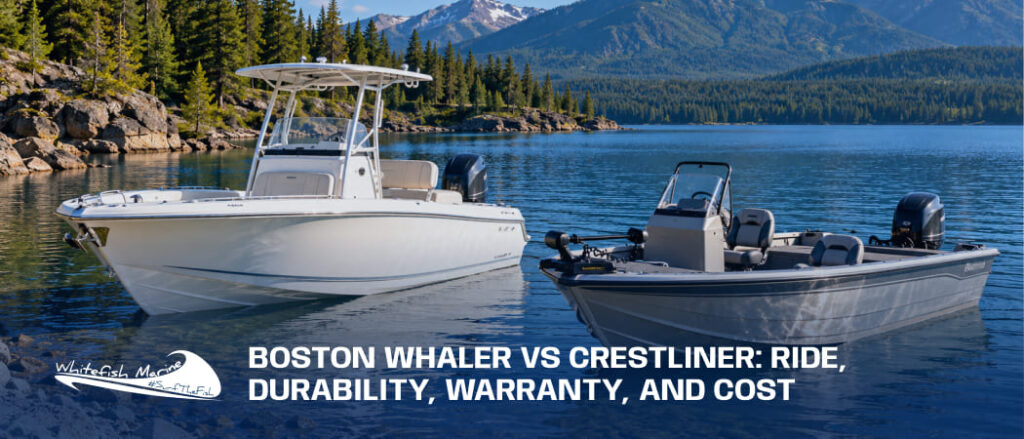
Most people treat Boston Whaler vs Crestliner as a budget call. Fiberglass is the expensive one, aluminum is the affordable one- pick by bank account.
That framing fails often enough to be worth taking apart. Both brands belong to Brunswick Corporation, both have been building boats since before 1960, and Crestliner overlaps Boston Whaler on price far more than the two reputations suggest.
The real split is water. Where a boat launches, what it scrapes against, and how far it runs from shore matter more than the sticker on either hull.
How Boston Whaler builds its fiberglass hulls
Boston Whaler once had a 13-foot hull sawn in half and photographed for LIFE magazine, founder Richard Fisher sitting calmly in one of the floating halves. The company has repeated some version of that demonstration for decades since.
What makes it possible is a process Whaler calls Unibond. Closed-cell foam goes in under high pressure between the hull’s inner and outer liners, up the sides as well as below the waterline, until the two layers cure into a single piece.
A conventional boat gets its stiffness from fiberglass stringers, with foam blocks dropped in for flotation. A Whaler gets stiffness and flotation from the same structure, which is why the unsinkable claim holds and why the boats ride quieter than their size suggests. The foam kills vibration that a hollow stringer box would pass straight into the deck.
The current range runs from 13-foot side consoles to the 42-foot 420 Outrage, every one built on the same core process. The smallest center console, the 150 Montauk, is 15 feet 5 inches, rated for 6 people and a 60 horsepower maximum.
Why Crestliner welds its aluminum hulls
Crestliner started in Little Falls, Minnesota, in 1946, and its defining decision was moving to all-welded hulls instead of riveted ones. Rivets corrode, loosen, and eventually weep. Welds don’t.
That one change is most of why Crestliner is comfortable putting a lifetime warranty on its hull seams while most of the industry won’t. The brand now builds out of Otsego, Minnesota, under Brunswick, and has taken the CSI Award for customer satisfaction in aluminum boats 18 years running.
On the hardware side, the AP-X hull is the piece worth knowing about. Interlocking aluminum panels with dual tracking edges hold a line through a turn and keep the boat straight at trolling speed. Crestliner limits it to select Deep-V fishing models, mostly 1750 through 1950 hulls, so confirm it on the specific boat.
Fiberglass vs Aluminum: The Differences that Matter
Fiberglass rides softer and quieter, aluminum survives contact that would put fiberglass in a repair shop, and nearly everything else people argue about follows from those two facts.
- Aluminum weighs less for a given length, which lowers towing requirements and fuel burn.
- Fiberglass absorbs chop better on open water, especially above 20 feet.
- Aluminum tolerates rocky launches, sandbars, and shallow rivers with dents instead of structural damage.
- Fiberglass repair means gelcoat work and specialized labor; aluminum repair is often a weld and an afternoon.
- Aluminum carries more engine and hull noise into the boat, and no amount of carpet fully fixes it.
What Each Warranty Actually Covers
Warranty length is a manufacturer betting on failure rates with its own money, which makes it more honest than marketing copy. Both brands bet heavily, in different places.
Boston Whaler covers the structural hull for ten years, components it builds or installs for three, and upholstery, canvas, teak, and powder coating for one. Crestliner covers welded hull seams for the original owner’s lifetime, the interior support structure for ten years, and nearly everything else bow to stern for three.
On paper, Crestliner wins the headline number. In practice, the lifetime portion is the part people misread. Crestliner’s lifetime seam coverage is not transferable. Sell the boat, and it converts to a prorated ten-year schedule running from the original purchase date, not the resale.
A transfer costs $250, applies only to model year 2010 and newer boats, and has to be filed within 30 days of purchase with a bill of sale. One more catch for used shoppers: the boat must still have time left on the interior support warranty for the transfer to go through at all.
Boston Whaler’s ten-year hull warranty transfers to a subsequent owner through a form on Whaler’s site. That narrows the gap between the two brands on the used market compared with the showroom floor.
Boston Whaler vs Crestliner at a Glance
| BOSTON WHALER | CRESTLINER | |
| FOUNDED | 1958 | 1946 |
| HULL MATERIAL | Fiberglass, foam-injected Unibond | All-welded aluminum |
| SIGNATURE HULL TECH | Unibond closed-cell foam core | AP-X interlocking panel hull |
| STRUCTURAL WARRANTY | 10 years, transferable | Lifetime seams, original owner only |
| COMPONENT WARRANTY | 3 years | 3 years |
| STRONGEST ON | Open water, chop, long runs | Shallow water, rocks, rivers |
Compiled from Boston Whaler and Crestliner published warranty and construction documents.
Match the Hull to the Water You Run
If the plan involves big open water, a Boston Whaler earns its price through ride quality and the safety margin of a hull that floats when it’s swamped. Flathead Lake is exactly that kind of water: the wind can build serious chop by mid-afternoon, and the boat you bring needs to handle it.
If the plan involves rivers, rocky shorelines, shallow launches, or trailering behind a mid-size vehicle, a Crestliner is built for exactly that. It takes damage that would mean a fiberglass repair bill.
Anglers who split time between both conditions usually land in an aluminum Deep-V, which is the compromise the AP-X hull was designed around. That puts most of them in the aluminum boats category rather than at either extreme.
What it Costs to Own, Not Just to Buy
Aluminum usually costs less upfront and less to fix after the bumps that come with rocky launches and regular trailering. But the warranty transfer terms above cut into that math at resale, so the cheaper purchase price doesn’t automatically mean a cheaper trade-in value.
Engine package, electronics, seating, and trailer setup move the final number more than hull material does. Both lines sit on the floor at Whitefish Marine in Whitefish, MT, alongside the rest of the fishing boats inventory. Call 406-862-8594 for current pricing on the exact boat and engine combination you’re weighing.